

You're Probably Making Hard Conversations Worse
Stop triggering defensiveness. Start getting heard.

Most people don’t realize they’re making hard conversations worse.
You raise a concern. The other person gets defensive. The issue never gets resolved. And somehow you end up managing their reaction instead of addressing the original problem.
The issue usually isn’t what you said. It’s how it landed. Specifically, whether what you said sounded like an observation or an accusation.
There’s a four-part framework that helps you say what you need to say without triggering defensiveness. It’s called OFNR.
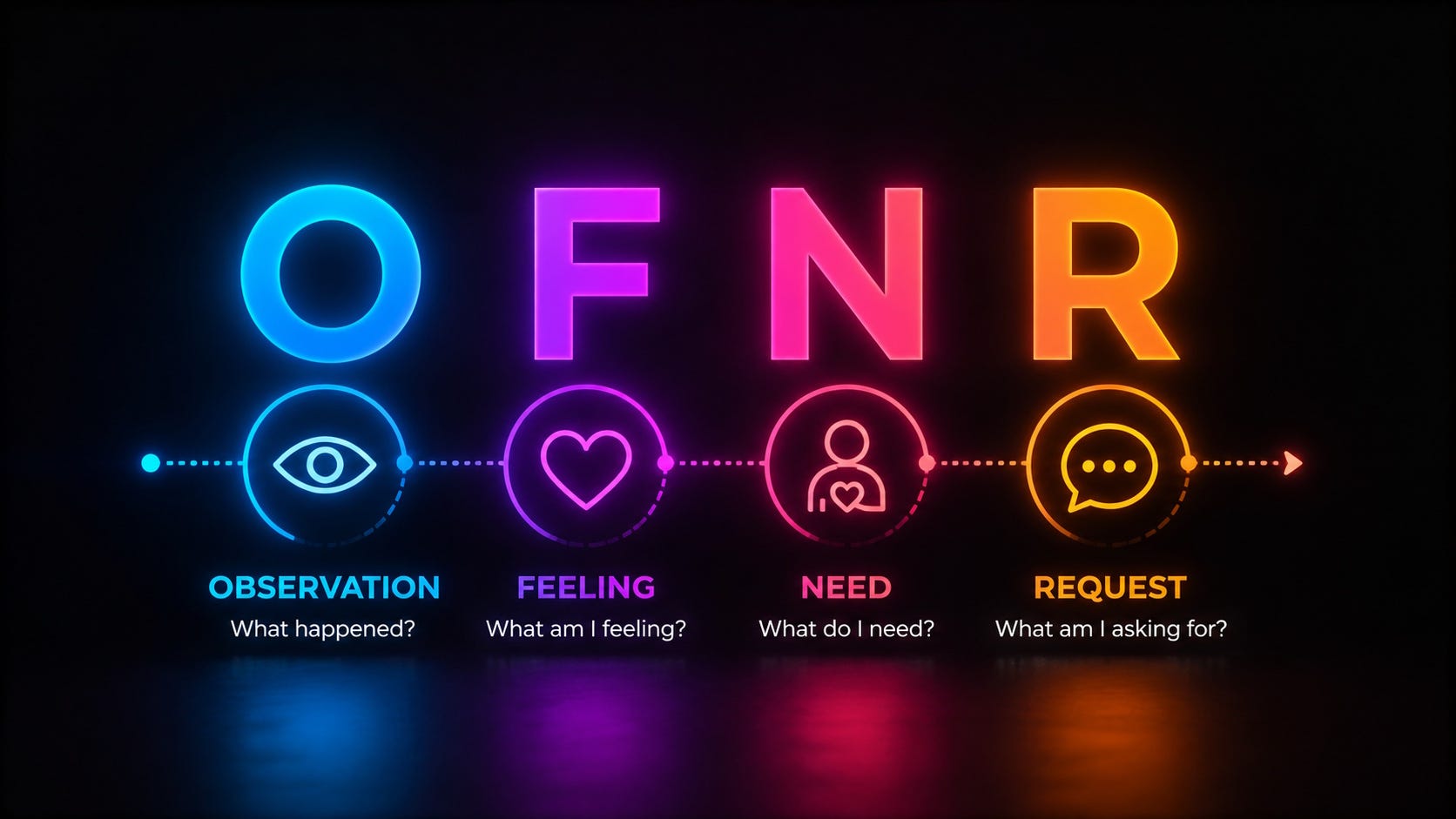
O — Observation: What happened?
Describe what happened without judgment or assumptions. Don’t guess what the other person was thinking or feeling. Just say what happened.
Say someone told you they’d drive you to the doctor and never came. Now you don’t have your medication, you’re out a cancellation fee, and you have to make another trip.
The observation is simply: “You said you’d drive me to the doctor and never came.”
No interpretation. No story. Just the event.
F — Feeling: What am I feeling?
Not everything that sounds like a feeling actually is one.
“I’m anxious.” “I’m frustrated.” Those are feelings.
“I feel uncared for.” That’s not a feeling. That’s a story. It’s the equivalent of saying, “You don’t care about me.”
People can feel multiple things at once. In this situation, you might be anxious about not having your medication and frustrated about missing the appointment.
“I’m anxious and frustrated.”
Same principle as the observation. You’re separating what you’re actually experiencing from the story in your head.
N — Need: What do I need?
This may be the single most important part to get right.
If someone hears you’re frustrated, they may or may not care. But when they understand that you could end up in the hospital without your insulin, they have a reason to care.
Just as you can have more than one feeling, you can have more than one need.
“I need my insulin. Without it, I could end up in the hospital. I also need to avoid paying another cancellation fee.”
R — Request: What am I asking for?
You’ve done the hard part. Now you tell them what would actually help.
You’re not demanding a specific outcome. You’re making one clear ask.
“Next time you’re picking me up, please let me know as soon as possible if something comes up so I can make other arrangements.”
All together:
“You said you’d drive me to the doctor and never came. I’m anxious and frustrated. I need my insulin. Without it, I could end up in the hospital. I also need to avoid paying another cancellation fee. Next time you’re picking me up, please let me know as soon as possible if something comes up so I can make other arrangements.”
No blame. No story. No attack to defend against.
That’s OFNR. One framework, four steps, and most hard conversations get a lot easier.
If you want help applying this in your own life, I work with people one-on-one. Book a free 30-minute discovery call at heartmindfusion.com.